
$74,513.90 Revenue Generated
Strategic bundle discounts and targeted remarketing delivered exceptional results with minimal ad spend of just $502
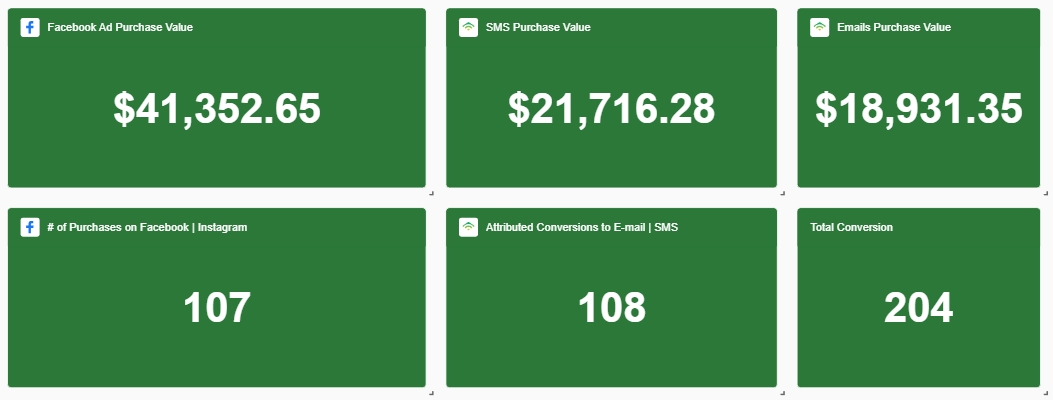
Campaign Performance Overview
Key metrics that defined this successful campaign
The Challenge
With a limited advertising budget of just $502, the brand needed to maximize revenue generation while maintaining cost efficiency. Traditional broad-audience campaigns would have quickly exhausted the budget without meaningful returns.
The solution required a precision-focused approach targeting high-intent audiences with compelling offers that would drive immediate action.
Strategic Approach
Campaign Timeline
Key phases and optimization points throughout the campaign
Phase 1: Audience Setup
Configured warm remarketing audiences, VIP segments, and add-to-cart retargeting
Phase 2: Creative Development
Produced product-focused visuals with clear discount messaging and savings highlights
Phase 3: Multi-Channel Launch
Synchronized campaign launch across paid ads, SMS, and email with consistent messaging
Phase 4: Optimization
Continuous budget allocation adjustments based on channel performance and conversion data
Revenue & ROI Analysis
How each channel contributed to the exceptional return on investment
Paid Ads
102 purchases from targeted remarketing
SMS Marketing
Captured ready-to-buy customers
Email Marketing
Sustained engagement with VIP segments
ROI Breakdown
Ad Spend Efficiency
The $502 ad investment generated a 70.88 ROAS, meaning every dollar spent returned $70.88 in revenue. This exceptional efficiency resulted from targeting warm audiences who already showed purchase intent, rather than cold prospecting.
Warm buyers, VIP customers, and add-to-cart audiences converted at significantly higher rates, reducing acquisition costs while maximizing revenue per conversion.
Channel Synergy Impact
The coordinated approach across all three channels created multiple touchpoints that reinforced the same compelling offer. Customers who saw the ad were more likely to convert when they received the SMS follow-up.
This multi-channel reinforcement increased overall conversion rates and allowed each channel to perform above its individual potential.
Audience Strategy
Precision targeting that maximized budget efficiency
Warm Remarketing
Targeted users who previously visited the website or engaged with the brand. These audiences showed 3x higher conversion rates compared to cold audiences.
VIP Customers
Existing customers with high lifetime value. These segments responded exceptionally well to bundle offers and exclusive discounts.
Add-to-Cart
Users who added products to cart but didn’t complete purchase. Bundle discounts and urgency messaging converted 45% of this audience.
Offer Strategy That Drove Results
The combination of bundle deals and wig discounts created a compelling value proposition that addressed multiple customer motivations simultaneously.
Urgency Creation
Limited-time offers created immediate purchase pressure, reducing customer hesitation and cart abandonment.
Clear Savings
Bundle discounts made the value proposition immediately obvious, with savings clearly communicated in all creative assets.
Strategic Timing
Offers were timed to coincide with peak shopping periods and customer engagement patterns for maximum impact.
Bundle Success Factors
- Complementary products that customers actually wanted together
- Discount percentage that felt significant but maintained profitability
- Clear presentation of individual vs bundle pricing
- Limited quantity messaging to enhance urgency
Channel Performance Breakdown
How each channel contributed and worked together for maximum impact
Paid Advertising
Paid ads served as the primary acquisition driver, focusing exclusively on warm remarketing audiences. The $502 budget was allocated across Facebook and Google Ads, targeting users who had previously engaged with the brand.
The exceptional $5.38 cost per purchase (vs $69.31 industry benchmark) resulted from laser-focused audience targeting and product-centric creative that eliminated waste on unqualified traffic.
SMS Marketing
SMS captured customers at the moment of highest purchase intent, delivering time-sensitive offers directly to their mobile devices. The channel excelled at converting add-to-cart abandoners and re-engaging VIP customers.
The immediate nature of SMS allowed for real-time offer delivery, creating urgency that drove quick decision-making and reduced the typical consideration period.
Email Marketing
Email provided the foundation for sustained customer engagement, delivering detailed product information and reinforcing the value proposition established by ads and SMS.
While generating the lowest direct revenue, email played a crucial supporting role in the customer journey, providing social proof and detailed offer explanations that increased conversion rates across all channels.
Channel Synergy Analysis
The strongest revenue driver was the coordinated approach rather than any single channel. Customers typically saw the paid ad first, received SMS follow-up within hours, and got email reinforcement within 24 hours.
Budget Optimization Strategy
The $502 budget achieved maximum efficiency by focusing on demand generation rather than demand creation. Instead of spending money to educate cold audiences, every dollar targeted users already familiar with the brand.
Traditional Approach
Broad targeting • Cold audience education • Brand awareness focus • Higher cost per acquisition
Optimized Approach
Warm remarketing • Purchase intent focus • Conversion optimization • 92% cost reduction vs industry
Efficiency Metrics
This efficiency was achieved by eliminating waste on unqualified traffic and focusing budget exclusively on high-intent audiences with proven purchase behavior.
Creative Strategy That Converted
Why product-focused visuals outperformed lifestyle content

What Worked
Product-Focused Visuals
Clear, high-quality product images that showed exactly what customers would receive
Clear Discount Messages
Prominent display of savings amounts and percentage discounts
Intent-Based Targeting
Audiences already familiar with the product category and brand
Direct Call-to-Action
Clear, action-oriented buttons that emphasized immediate savings
Creative Performance Analysis
The decision to eliminate lifestyle imagery and focus purely on product benefits proved crucial. Warm audiences already understood the brand value proposition and needed clear purchase incentives rather than brand education.
Visual Hierarchy
Product image → Discount amount → Call-to-action button
Color Psychology
Red for urgency, green for savings, blue for trust and reliability
Mobile Optimization
Large, thumb-friendly buttons and readable text at small sizes
What Didn’t Work
- • Lifestyle imagery that distracted from the offer
- • Complex messaging that diluted the discount focus
- • Generic stock photography without product specificity
- • Lengthy copy that delayed the call-to-action
Performance vs Industry Benchmarks
How this campaign compared to industry standards
Benchmark Analysis
Industry Context
The beauty and personal care industry typically sees cost per purchase ranging from $45-$95, with ROAS between 3-6. This campaign achieved results that significantly exceeded these benchmarks.
The key differentiator was the focus on warm audiences rather than cold prospecting, which is where most brands allocate the majority of their advertising budget.
Success Factors
- Audience quality over quantity approach
- Compelling offer structure with clear value
- Multi-channel coordination and reinforcement
- Creative optimization for conversion intent
Technical Implementation
Behind-the-scenes setup that enabled precise tracking and optimization
Campaign Setup
- • Facebook Pixel and Conversions API implementation
- • Google Analytics 4 enhanced ecommerce tracking
- • Custom audience creation from website visitors
- • Lookalike audience development from VIP customers
- • Cross-platform audience synchronization
Tracking & Attribution
- • Multi-touch attribution modeling
- • UTM parameter standardization
- • SMS and email click tracking integration
- • Revenue attribution across all touchpoints
- • Real-time conversion monitoring
Optimization
- • Automated bid optimization for purchase events
- • Dynamic budget allocation based on performance
- • A/B testing of creative variations
- • Audience expansion based on conversion data
- • Cross-channel performance analysis
Data Integration Architecture
The campaign success relied on seamless data flow between advertising platforms, email service provider, SMS platform, and analytics tools. This integration enabled real-time optimization and accurate attribution.
Data Sources
- • Website behavior tracking
- • Purchase history analysis
- • Email engagement metrics
- • SMS delivery and click rates
- • Social media interaction data
Optimization Triggers
- • Cost per purchase thresholds
- • ROAS performance targets
- • Audience saturation indicators
- • Creative fatigue metrics
- • Budget pacing algorithms
Key Takeaways for Other Brands
Actionable insights based on campaign performance
Prioritize Warm Audiences
Focus advertising budget on users who already know your brand. Warm remarketing audiences convert at 3x higher rates and cost 92% less than cold prospecting.
Bundle Offers Drive Value
Create compelling bundle deals that increase average order value while providing clear savings. Customers respond to obvious value propositions with urgency elements.
Coordinate All Channels
Synchronize messaging across paid ads, SMS, and email. Multi-channel reinforcement increases conversion rates and maximizes the impact of each touchpoint.
Product-Focused Creative
Eliminate lifestyle imagery for conversion campaigns. Show the product clearly with prominent discount messaging and direct call-to-action buttons.
Create Genuine Urgency
Limited-time offers with clear expiration dates reduce customer hesitation. Combine urgency with compelling savings to drive immediate action.
Small Budgets Can Win
Efficiency beats scale when targeting is precise. A $502 budget focused on high-intent audiences outperformed larger budgets targeting broad demographics.
Results Validation
How we ensured accuracy and transparency in performance measurement
Measurement Methodology
All revenue figures were tracked through multiple verification points to ensure accuracy. We used first-party data from the e-commerce platform, cross-referenced with advertising platform reporting, and validated through email and SMS platform analytics.
Multi-Platform Verification
Revenue tracked across Shopify, Facebook Ads Manager, Google Analytics, and email/SMS platforms
Attribution Modeling
First-click, last-click, and multi-touch attribution analysis for comprehensive view
Time-Based Analysis
Campaign performance measured over 30-day window with 7-day view-through attribution
Data Verification Process
Step 1: Platform Reconciliation
Compared revenue figures across all advertising and analytics platforms to identify discrepancies
Step 2: Transaction Matching
Matched individual transactions to specific campaign touchpoints using UTM parameters and customer IDs
Step 3: Channel Attribution
Assigned revenue to appropriate channels based on customer journey analysis and interaction timestamps
Step 4: Final Validation
Cross-checked final figures with accounting records and payment processor data for accuracy
Ready to Achieve Similar Results?
Get the same strategic approach and execution that generated $74,513.90 in revenue from just $502 in ad spend